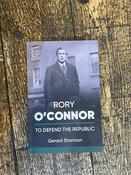
Rory O Connor: To Defend the Republic by Gerard Shannon The execution of IRA leader Rory O Connor on 8 December 1922, along with Liam Mellows, Dick Barrett and Joe McKelvey, marked a bitter turning point in the Irish Civil War and remains one of the most infamous episodes in modern Irish history. An unlikely revolutionary, in his early years, O Connor qualified as an engineer and worked on the Canadian railroad. Returning to Ireland in 1915, he joined the ranks of militant Irish republicanism and became devoted to the violent overthrow of British rule. After playing his part during the Easter Rising, in its aftermath he became a key figure in rebuilding the revolutionary movement. By the outset of the Irish War of Independence, O Connor was the IRA s Director of Engineering and also worked in the Dáil s Local Government department, where he began a close friendship with Kevin O Higgins, who would later sit on the government cabinet that approved O Connor s execution. On the signing ...
General Liam Lynch was a key figure in the Irish Revolution and remains one of the most celebrated IRA leaders of his era. His republicanism was shaped both by his upbringing in Limerick and by the aftermath of the Easter Rising. By the time of the War of Independence, Lynch was in command of the IRA’s Cork No. 2 Brigade and masterminded some of the most important actions against British forces, such as the Fermoy arms raid and the daring kidnapping of British General Cuthbert Lucas.
Adamantly opposed to the Anglo-Irish Treaty, regarding it a betrayal of the Irish Republic, Lynch became chief of staff to the IRA men who opposed the settlement. Yet he remained determined to find a compromise with former comrades, which left him little prepared for the outbreak of the Irish Civil War.
Lynch would not live to see the end of the bitter conflict – he was mortally wounded following a dramatic pursuit by Free State forces across a mountain in south Tipperary – yet his controversial leadership of the IRA during the eleven-month Civil War continues to shape his legacy today.
In this long-awaited and fascinating new biography, the first in nearly forty years, historian Gerard Shannon delves deep into a wide array of archival material to create a detailed, nuanced portrait of a hugely significant and influential figure in Irish history.